
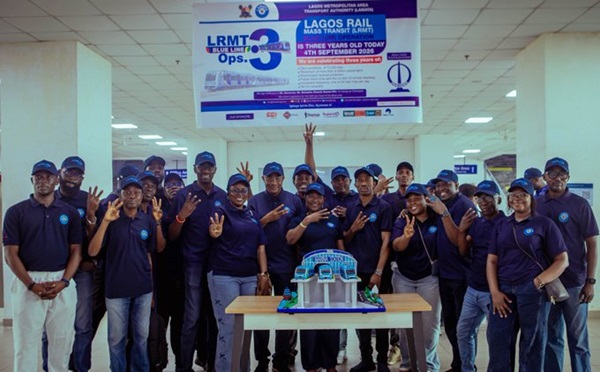
The Lagos Rail Mass Transit Blue Line has transported more than nine million passengers in over 70,000 trips since it commenced commercial operations on September 4, 2023, the Lagos Metropolitan Area Transport Authority (LAMATA) has said. In a post on X marking the third anniversary of the service, LAMATA said……
The Lagos Rail Mass Transit Blue Line has transported more than nine million passengers in over 70,000 trips since it commenced commercial operations on September 4, 2023, the Lagos Metropolitan Area Transport Authority (LAMATA) has said.
In a post on X marking the third anniversary of the service, LAMATA said the rail line had become a major alternative to road transportation by providing safer, faster and more predictable journeys for commuters travelling between the mainland and Lagos Island.
Commercial operations on the Blue Line commenced on September 4, 2023, with the service initially running 12 trips daily. The line now operates about 94 trips per day, with trains arriving at 10-minute intervals during peak periods and an operational reliability rate of approximately 99.5 per cent.
Read Also: Lagos To Begin Compensation For Blue Line Depot land acquisition
The milestone comes as the Lagos State Government works to complete the infrastructure required to extend the Blue Line from its existing Mile 2-Marina corridor to Okokomaiko by 2027.
The increased frequency of services has helped commuters avoid congestion on major road corridors, while supporting the state government’s broader plan to build an integrated public transportation network and reduce dependence on private vehicles.
To commemorate the anniversary, Commissioner for Transportation Oluwaseun Osiyemi led LAMATA Managing Director Abimbola Akinajo, Technical Adviser for Public Transport (Rail) Olasunkanmi Okusaga and the Touch and Pay team, led by Managing Director Olamide Afolabi, to Marina Station, where commuters received celebratory gifts.
The gesture was aimed at appreciating passengers for their continued patronage of the rail service.
Akinajo said the Blue Line had demonstrated the value of modern rail transportation through improved journey times, service reliability and effective revenue protection.
She said, “The Blue Line has demonstrated the benefits of modern rail transportation through faster journey times, improved service reliability and effective revenue protection.”

According to her, the 10-minute peak-period headway had further strengthened the appeal of the service to commuters.
Akinajo also highlighted the environmental benefits of the electrically powered rail line, noting that increased mass-transit patronage could help reduce the number of private and other road-based vehicles on Lagos roads.
She said the expansion of rail transportation formed part of the state’s strategy to develop a cleaner, low-emission transport system in line with its long-term zero-emission ambition.
The Blue Line has also generated employment opportunities across railway operations, engineering, maintenance, security, station management, ticketing, customer service and cleaning.
Akinajo disclosed that more than 95 per cent of the workforce are Nigerians, describing the figure as an indication of the project’s contribution to local employment and skills development.
She added that commercial activities around stations were increasing as improved connectivity attracted residents and businesses along the rail corridor.
According to her, the trend could accelerate through Transit-Oriented Development, which integrates residential, commercial and recreational activities around efficient public transport systems.
Akinajo said effective implementation of TOD around Blue Line stations could transform surrounding communities into economic centres where residents could live, work, shop and access essential services with less reliance on private cars.
The Lagos State Government is targeting 2027 for the completion of the remaining infrastructure required to extend the Blue Line to Okokomaiko.