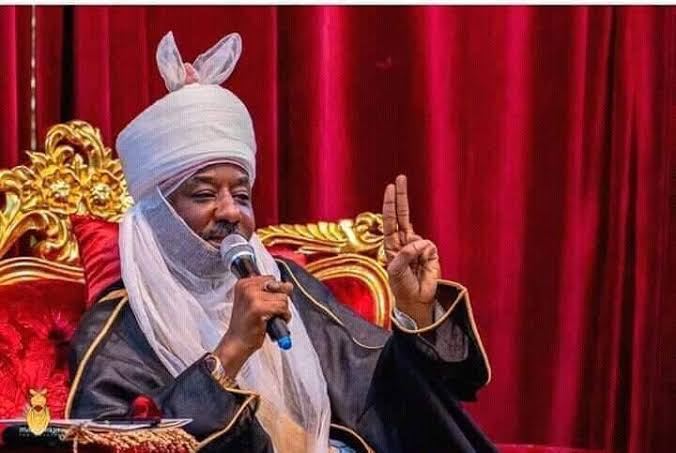
The Emir of Kano, Muhammadu Sanusi II, has called for a clearer separation between religion and politics, urging religious leaders to focus on spiritual matters and politicians on governance.
Sanusi spoke on Thursday in Abuja at the public presentation of Military Transformational Leadership in Action: The Buratai Era.
He said the growing involvement of religious leaders in politics had blurred the distinction between the two roles.
“It is not the responsibility of politicians to give us religion. They are there to give us education, to give us healthcare, and to give us an economy,” Sanusi said.
He added, “It is also not the duty of religious leaders to get into politics.”
The emir said the situation had become so pronounced that religious and political identities were increasingly overlapping.
“Right now, there’s no distinction between imams and bishops and senators. Everybody is a politician,” he said.
Sanusi also warned that the politicisation of religion and ethnicity could deepen Nigeria’s security challenges.
He argued that the country’s current security problems did not begin with banditry, Boko Haram or terrorism, but were preceded by divisive political rhetoric that increasingly encouraged Nigerians to identify along ethnic, regional and religious lines.
“Until we begin to walk back from the politicisation of ethnicity and the politicisation of religion and free our politics from these base considerations, we are only laying the foundation for a new round of violence,” he said.
He urged Nigerians to prioritise their common national identity and focus on development.
Sanusi also called for institutions such as the military, police, Central Bank of Nigeria, judiciary and media to remain insulated from partisan politics.
He said strong leadership alone could not guarantee effective governance without strong institutions.
“A strong leader cannot perform if the institution itself is not strong. And no matter how strong an institution is, if you place a weak leader on top of it, he destroys it,” he said.
The emir said institutions should operate according to their legal and professional responsibilities and remain capable of checking political power.
“The moment we all get absorbed into the projects of politicians, we cannot hold political society in check,” he said.
Sanusi also urged national institutions to adopt longer-term planning rather than operate around four-year electoral cycles.
“The army cannot think in four-year cycles. The police cannot think in four-year cycles. The central bank cannot think in four-year cycles,” he said.