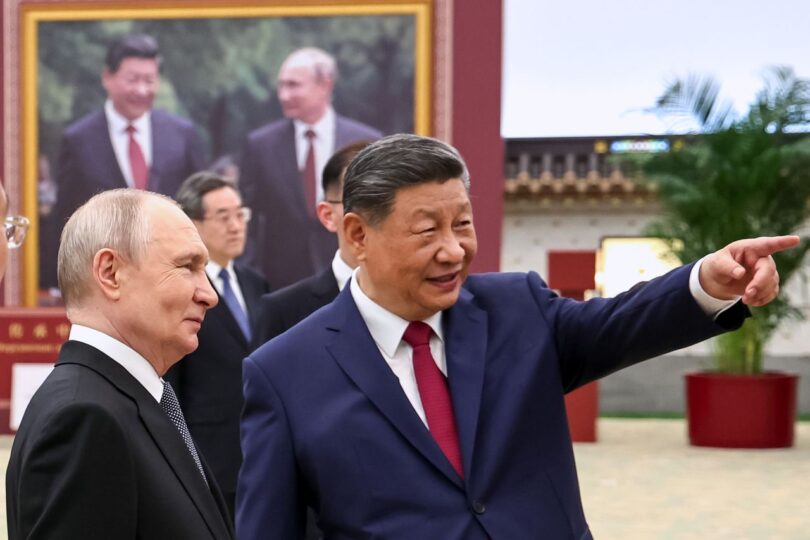
“Therefore, Putin’s visit serves not so much as a reduction in Russia’s dependence on China, but rather as an external reminder confirming how deep and permanent this dependence is in the international system.”
The asymmetry is also increasingly visible diplomatically. Moscow has aligned itself more closely with Beijing’s positions on issues ranging from Taiwan and Hong Kong to Xinjiang, while both countries continue coordinating within non-Western platforms such as BRICS and the Shanghai Cooperation Organisation.
Eugene Chausovsky, an expert on Russian politics, says Moscow-Beijing ties have gained additional importance amid the widening regional fallout from the Iran conflict.
According to several reports, Russia, like China, has politically backed Iran in the face of US-Israeli pressure, praising Tehran’s resilience despite mounting Western pressure.
During his Beijing visit, Trump also reportedly sought Xi’s support for securing stability around the Strait of Hormuz, though no major Chinese commitment emerged from the summit.
Is Russia becoming a junior partner?
Despite Russia’s mounting economic difficulties and growing reliance on Chinese markets and technology, experts caution against viewing the relationship as one in which Beijing seeks outright dominance of Moscow.
Related
They argue that China and Russia remain pragmatic partners bound not only by strategic necessity, but also by decades of ideological overlap and shared opposition to Western influence.
Chausovsky is among those who reject the idea that the relationship is evolving into a straightforward hierarchy, even as Russia’s dependence on China has deepened significantly since the start of the war in Ukraine in 2022.
“Rather, Russia and China have a flexible and evolving strategic partnership that varies by topic and rests on where both sides can mutually benefit, both practically and in their efforts to challenge a US/Western-led global order,” he tells TRT World.
“Both Moscow and Beijing have made an effort not to frame this relationship as lop-sided or inferior. The reality is that they have established a workable division-of-labor, with Russia providing key energy resources and other commodities, while China serves as a large market that (along with other countries like India), presents Russia with a viable alternative to the West.”
According to him, both sides have deliberately avoided framing the partnership as unequal or subordinate.
At the same time, analysts familiar with Kremlin thinking say Moscow would never willingly accept junior-partner status regardless of China’s growing economic weight.
That sentiment was recently echoed by Dmitry Trenin, president of the Moscow-based Russian International Affairs Council, in an article titled “We Bow to No One.”
Experts also note that despite speculation over China’s growing leverage, both countries remain closely aligned on major geopolitical issues, including Iran and opposition to Western pressure campaigns. Beijing, in particular, has been careful not to undermine Russian interests regarding the Ukraine war.
From this perspective, Oleg Ignatov, senior Russia analyst at the International Crisis Group, also rejects the idea of a deeply asymmetrical relationship.
“There are no disputes or conflicts in relations between the two countries, nor is there any tension,” Ignatov tells TRT World.
“This is an example of strategic relations showing just how far they can go without a military alliance and without one side dominating the other. Moscow and China are satisfied with how these relations are developing.”
According to Ignatov, China has consciously avoided exploiting Russia’s vulnerabilities despite holding a stronger economic position.
“China accepts Russia’s interests as they are, without dictating to Russia what to do, which suits Moscow,” he says.
Still, he acknowledges that Russia’s options have narrowed significantly since the war in Ukraine severed much of its economic relationship with Europe.
“Moscow has no other choice because China has replaced Europe for Russia for its energy exports due to the Ukraine war,” Ignatov says.
Yet even under these conditions, Beijing appears intent on preserving the appearance, and perhaps the reality, of strategic equality.
“Given its stronger economic and political position, China could use this to its advantage more, but it is not doing so. China considers Russia a neighbor with whom it is important to maintain good relations and an equal relationship.”