
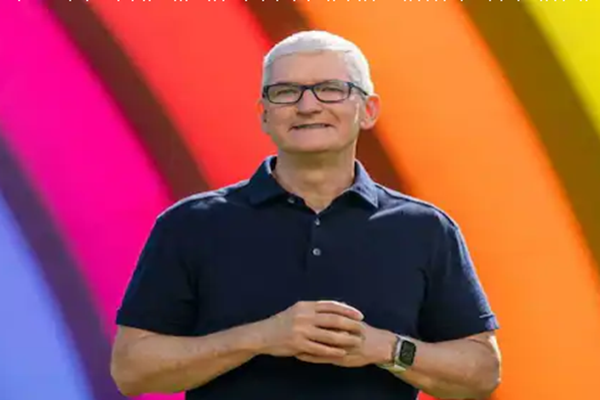
Tim Cook is set to leave his role as Apple CEO, bringing an end to a 15-year tenure in which he transformed the company’s operations while steering it through a period of enormous growth and change. According to a report by Firstpost, Cook will move into the role of executive……
Tim Cook is set to leave his role as Apple CEO, bringing an end to a 15-year tenure in which he transformed the company’s operations while steering it through a period of enormous growth and change.
According to a report by Firstpost, Cook will move into the role of executive chairman, while John Ternus, Apple’s senior vice president of hardware engineering, is set to succeed him as CEO.
Cook joined Apple in March 1998 as senior vice president for worldwide operations, arriving at a company undergoing a major restructuring. His expertise was not in industrial design or product development but in making large-scale operations more efficient.
He quickly began reshaping Apple’s manufacturing model. Factories and warehouses were closed, while production increasingly shifted to contract manufacturers. The strategy significantly reduced the amount of time products spent in Apple’s inventory, taking stock levels from months’ worth of products to only a matter of days.
Cook also adopted a long-term strategy for securing critical components. His team invested in supplies such as flash memory before demand surged, helping Apple secure components that would later be used in products including the iPod Nano, iPhone and iPad.
The work gave Cook an increasingly important role in Apple’s wider business operations. He later served as vice president for worldwide sales and operations before taking responsibility for the company’s operations in January 2007 and eventually becoming chief operating officer.
Cook’s importance became particularly evident during Steve Jobs’ periods of medical leave. While Jobs remained involved in major decisions, Cook handled much of Apple’s day-to-day management, gaining valuable experience running the company at its highest level.
That experience helped make the eventual leadership transition less abrupt. When Jobs resigned as CEO in 2011, Apple appointed Cook as his successor on August 24 of that year.
The change was significant, but Cook was hardly an outsider taking charge. By then, he had spent more than a decade developing a deep understanding of Apple’s internal operations and had already played a major role in running the business.
Read Also: Apple Referred For Criminal Contempt Investigation
His leadership style also differed from Jobs’ highly product-focused approach. Cook placed greater emphasis on execution, organisational structure and collaboration, while also giving increased attention to Apple’s charitable and environmental initiatives.
One of the clearest examples of Cook’s management style emerged in 2012, when Apple reorganised responsibilities among senior executives following problems surrounding Apple Maps and changes in the company’s performance.
Rather than positioning himself primarily as the company’s product visionary, Cook increasingly became the executive overseeing a vast global organisation, balancing product development with supply chains, personnel, strategy and execution.
That distinction has remained central to understanding Cook’s tenure. His influence has often been less visible in the spotlight and more evident in the systems and structures supporting Apple’s products and business.
Cook’s departure from the CEO position will not mark the end of his association with Apple. From September 1, he is expected to serve as executive chairman, retaining a senior position within the company as Ternus takes over as CEO.
For Apple, the succession represents a carefully planned transfer of leadership. For Cook, it closes a remarkable journey that began with an operations role in 1998 and eventually took him to the company’s top position.
His career at Apple has therefore come full circle in an unusual way. The executive who once focused on making the company’s operations more efficient will move away from its day-to-day management and into a senior boardroom role, leaving the running of Apple to a new generation of leadership.