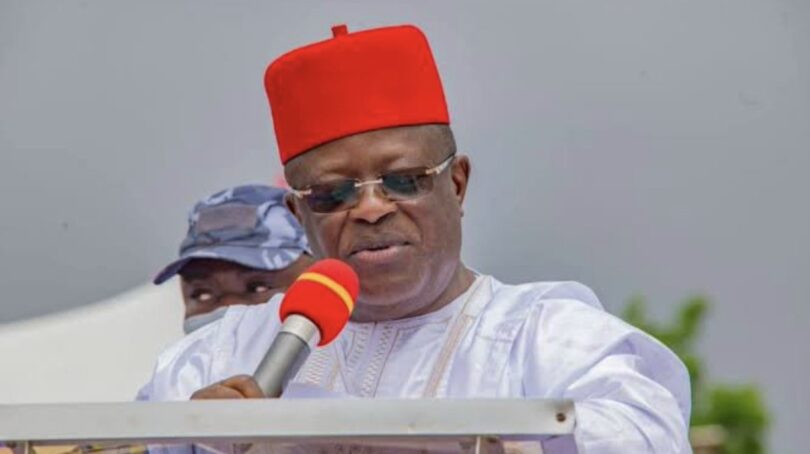
Minister of Works, David Umahi, says the Southeast will not be left behind in the distribution of infrastructure projects and the economic opportunities arising from the Federal Government’s development programme….
Minister of Works, David Umahi, says the Southeast will not be left behind in the distribution of infrastructure projects and the economic opportunities arising from the Federal Government’s development programme.
Umahi spoke during an inspection of the Calabar-Abuja Superhighway in Ado, Benue State, while defending the distribution of projects under President Bola Ahmed Tinubu.
The minister dismissed claims that he had concentrated Federal Government projects in the Southeast, saying the projects were part of the President’s broader national infrastructure programme.
“I saw on social media where they say I cornered all projects to Southeast. That is very wonderful.
But we have the publication of all projects ongoing by President Bola Ahmed Tinubu, so they darken counsel without knowledge,” he said.
Umahi stressed that the infrastructure programme was not his personal initiative but part of the President’s national development agenda.
“I’m not on my own. The President is my boss. So where will he be when I corner all projects to Southeast?” he asked.
He said while the Southeast might not rank first, second or third in the distribution of infrastructure projects, the region would “definitely” not be the last.
Umahi said the scale of ongoing infrastructure development was important not only for road connectivity but also for economic activity and opportunities for people in the communities where the projects were being executed.
He cited the Ebonyi State ring road as an example of how infrastructure investment could create long-term economic value, recalling that $150 million was borrowed during his tenure as governor to construct 199 kilometres of the road.
The minister also defended the decision to invest in infrastructure rather than prioritise savings, saying projects create assets that can support economic activity.
“You can’t save food where the people are hungry,” Umahi said.
He further disclosed that four legacy infrastructure projects under the Tinubu administration were being financed through a combination of Federal Government and foreign funding, with 30 per cent provided in naira by the Federal Government and 70 per cent through foreign financing.
Umahi said the administration’s approach was aimed at ensuring that major infrastructure projects were completed and capable of contributing to economic development across the country.
He also rejected suggestions that the Federal Government had abandoned existing roads in favour of new projects, explaining that several legacy projects involve the expansion and reconstruction of existing road corridors.
The minister said the infrastructure programme should be assessed based on projects already under construction and their impact on communities, rather than solely on future promises.