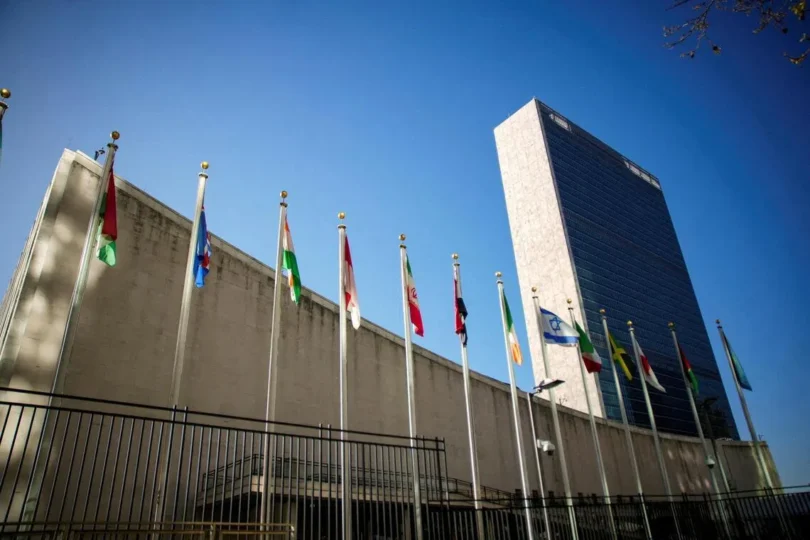
UNITED NATIONS – Talks at the UN to reaffirm nuclear non-proliferation and disarmament goals failed on May 22, according to the leader of the talks, after four weeks of negotiations held amid low expectations.
Vietnam’s Do Hung Viet, the president of the conference, said that “despite our best efforts… it is my understanding that the conference is not in a position to achieve agreement on its substantive work”.
“I do not intend to put the document forward for adoption,” he added.
Negotiators were reviewing the Treaty on the Non-Proliferation of Nuclear Weapons (NPT), the cornerstone of nuclear weapons control, amid fears of a renewed arms race. Previous reviews in 2015 and 2022 were also unsuccessful.
With expectations low, participants negotiated over a repeatedly reviewed and watered-down text, which they ultimately failed to adopt.
Experts pointed out that even in the absence of a review agreement for the third time in a row, the treaty continues to exist, but with diminished legitimacy.
“The text keeps on becoming less and less anchored in the realities of current conflicts and proliferation risks,” including North Korea and Iran, analyst Richard Gowan of the International Crisis Group said before the outcome was announced.
The latest version of the text seen by AFP on May 22 merely stated that Tehran must “never” develop nuclear weapons.
The paragraph was in brackets, signaling persistent disagreement, despite the removal of the reference to Iran’s “non-compliance” with its obligations that appeared in the first draft.
Also gone were expressions of concern about North Korea’s nuclear programme, or even any mention of the “denuclearisation” of the Korean Peninsula.
Gone as well was the direct call on the United States and Russia to begin negotiations on a successor to the New START treaty limiting Russian and American arsenals, which expired in February.
The diluted text still covered “the risk of a resumption of nuclear testing by Russia, China and the United States, the growth of arsenals, and attacks on nuclear infrastructure”, Ms Heloise Fayet of the French Institute of International Relations said earlier on May 22.
Exactly why the review failed isn’t yet known.
“The majority of countries are indeed working in good faith for disarmament,” said Mr Seth Shelden of the International Campaign to Abolish Nuclear Weapons (ICAN), commenting on the failure of the talks.
“But the small handful of nuclear-armed states, and certain of their allies, are undermining the NPT, frustrating disarmament efforts, expanding arsenals and provoking proliferation, and pointing the world toward catastrophe,” he added.
According to the Stockholm International Peace Research Institute (SIPRI), the nine nuclear-armed states – Russia, the United States, France, the United Kingdom, China, India, Pakistan, Israel and North Korea – possessed 12,241 nuclear warheads in January 2025, 90 per cent of which were in American and Russian hands.
Some countries are modernising their arsenals or even increasing their stockpiles.
The NPT, which entered into force in 1970 and has been signed by almost all states – with notable exceptions including Israel, India and Pakistan – aims to prevent proliferation, promote complete disarmament and encourage cooperation for the peaceful use of nuclear energy. AFP