By Aminu Abubakar
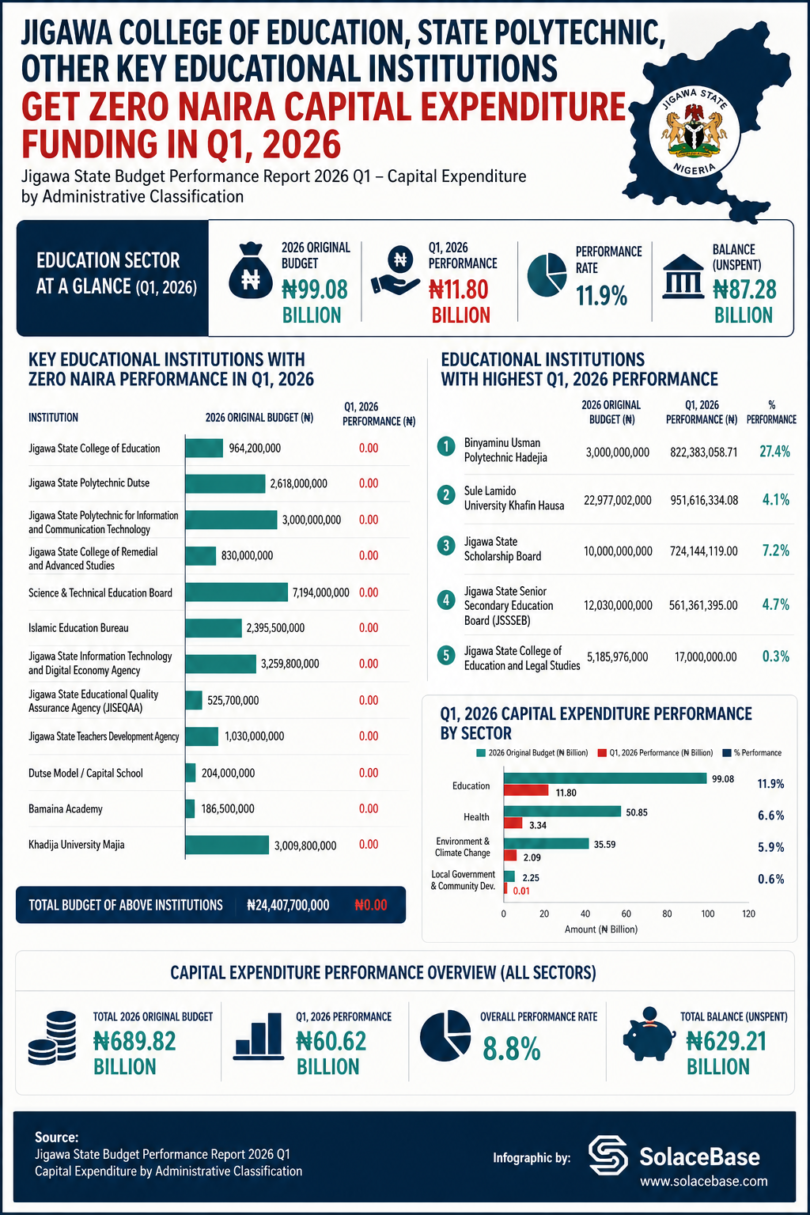
A SolaceBase review of the Jigawa State Government’s Budget Performance Report for the first quarter of 2026 has shown that several key educational institutions under the Ministry of Higher Education, Science and Technology recorded zero capital expenditure between January and March, despite allocations made in the 2026 fiscal year budget.
The report indicates that while funds were appropriated for capital projects across various institutions, no capital releases were recorded for a number of them within the period under review. This reflects a wide variation in implementation levels across agencies under the ministry, even as overall capital spending continued at state level.
Under the Ministry of Higher Education, Science and Technology, which has a total capital budget of ₦99.08 billion, aggregate capital expenditure for the first quarter stood at ₦11.80 billion. This represents 11.9 percent performance for the period. However, the breakdown of expenditure shows that a significant number of agencies and institutions under the ministry did not record any capital utilisation during the quarter.
Among the institutions with zero capital expenditure is the Jigawa State College of Education, which had an approved capital allocation of ₦964.2 million but recorded no spending between January and March. Similarly, the Jigawa State Polytechnic, Dutse, with a capital budget of ₦2.62 billion, also recorded zero capital expenditure within the same period.
Read Also:Jigawa Auditor-General flags billions of naira in unresolved audit queries across MDAs
Other institutions under the same ministry also showed no capital releases. The Jigawa State College of Remedial and Advanced Studies, with a budget of ₦830 million, recorded zero expenditure, while the Jigawa State Polytechnic for Information and Communication Technology, allocated ₦3 billion, also recorded no capital performance for the quarter. Khadija University, Majia, which had a ₦3 billion capital allocation, likewise recorded zero capital expenditure.
Several agencies and boards under the ministry followed the same pattern. The Science and Technical Education Board, with a capital budget of ₦7.19 billion, recorded no expenditure. The Islamic Education Bureau, allocated ₦2.40 billion, also recorded zero capital releases. The Jigawa State Information Technology and Digital Economy Agency, with a capital budget of ₦3.26 billion, similarly recorded no capital spending within the period.
Further zero capital performance was recorded by the Jigawa State Teachers Development Agency, which had ₦1.03 billion allocated; the Jigawa State Education Resources Agency, with ₦47.6 million; Dutse Model School, with ₦204 million; and Bamaina Academy, with ₦186.5 million. All these institutions recorded no capital expenditure in the first quarter of 2026.
Despite the widespread absence of capital releases in several institutions, some agencies within the ministry recorded partial performance. Binyaminu Usman Polytechnic, Hadejia, reported ₦822.38 million in capital expenditure out of its ₦3 billion allocation, representing 27.4 percent implementation for the quarter. Sule Lamido University, Kafin Hausa, recorded ₦951.62 million out of a ₦22.98 billion allocation, translating to 4.1 percent performance.
The Jigawa State Scholarship Board also recorded some level of expenditure, with ₦724.14 million spent out of a ₦10 billion budget, representing 7.2 percent performance. The Jigawa State Senior Secondary Education Board recorded ₦561.36 million out of ₦12.03 billion, which amounts to 4.7 percent capital performance within the same period.
Read Also:Kafin Hausa, Ringim, Dutse lead in teacher deficit as Jigawa fails to meet students ratio
At the ministry headquarters level, the Ministry of Higher Education, Science and Technology recorded a significantly higher level of capital utilisation compared to its agencies. The headquarters spent ₦8.72 billion out of a ₦20.63 billion allocation, representing 42.3 percent performance in the first quarter.
In the basic education sub-sector, a similar pattern of low capital releases was observed. The Ministry of Basic Education, which had a capital budget of ₦15.66 billion, recorded no capital expenditure in the first quarter of the year. Several agencies under the ministry also recorded zero capital performance during the period.
These include the Agency for Mass Education, with a ₦400 million capital allocation; the Nomadic Education Agency, allocated ₦923.14 million; the Library Board, with ₦80 million; and the Tsangaya Education Board, which had a capital budget of ₦3.60 billion. All these agencies recorded no capital expenditure between January and March 2026.
Within the same sub-sector, only one agency recorded capital spending. The State Universal Basic Education Board spent ₦1.62 billion out of a ₦27.82 billion allocation, representing 5.8 percent performance for the quarter.
Across all sectors in the state, total capital expenditure for the first quarter of 2026 stood at ₦60.62 billion out of a total budget of ₦689.82 billion. This represents an overall performance of 8.8 percent for the period under review, indicating relatively low budget implementation in the early part of the fiscal year.
In the health sector, some institutions also recorded no capital expenditure during the quarter. The Office of the Provost, College of Nursing Science, with a budget of ₦2.74 billion, recorded zero capital spending. Similarly, the College of Health Science and Technology, Jahun, which had an ₦800 million allocation, recorded no capital expenditure during the same period.
Read Also:Sokoto neglects Primary Healthcare, disburses just 5% of capital budget in 2025
Other sectors showed varying levels of capital performance. The Ministry of Works and Transport recorded ₦32.37 billion in capital expenditure out of a ₦186.37 billion allocation, representing 17.4 percent performance. The Ministry of Power and Renewable Energy spent ₦2.02 billion out of ₦49.84 billion, representing 4.1 percent performance.
The Ministry of Commerce, Industries and Co-operatives recorded ₦490.69 million out of a ₦17.08 billion allocation, representing 2.9 percent performance, while the Ministry of Water Resources recorded ₦869.20 million out of ₦21.84 billion, representing 4.0 percent capital expenditure performance.
Overall, the report highlights differences in capital budget implementation across ministries, departments, and agencies within Jigawa State during the first quarter of 2026. While some sectors and institutions recorded partial expenditure, several others had no capital releases at all within the period under review, reflecting uneven disbursement patterns across government institutions.