
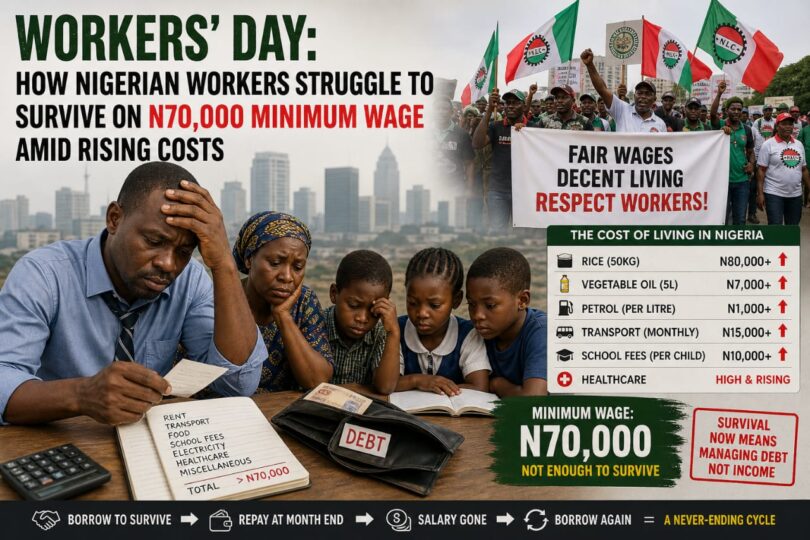
Nigerian workers on Friday marked this year’s Workers’ Day amid worsening economic hardship, as many say the N70,000 minimum wage can no longer sustain basic living in the face of rising fuel prices, food inflation, and healthcare costs.
This week, SolaceBase newsletter examines how the cost-of-living crisis is reshaping the daily realities of workers, with many now trapped in a cycle of debt just to survive.
Across the country, labour leaders and civil society organisations warned that the economic pressure on workers is intensifying.
The Civil Society Legislative Advocacy Centre (CISLAC) said the celebration comes at a time when millions of Nigerians are struggling with rising living costs and deepening inequality.
Its Executive Director, Auwal Musa Rafsanjani, noted that many workers continue to live under harsh conditions despite their contributions to national development, blaming structural weaknesses and ineffective welfare systems.
Similarly, the Trade Union Congress (TUC) renewed calls for reforms, with its President, Festus Osifo, stressing the need for fair policies and improved welfare to boost morale and productivity in the public service.
Read Also:Insecurity, poverty crushing Nigerian workers – NLC, TUC
But beyond policy conversations, workers say survival has become a daily struggle. For a typical household with one wife and three children in school, the N70,000 monthly wage is quickly exhausted.
A civil servant who spoke to SolaceBase on the condition of anonymity said his salary rarely lasts beyond two weeks.
“After paying for transport and food, the money is gone. Before the middle of the month, I start borrowing.”
At the end of the month, I use my salary to settle debts, and the cycle continues,” the civil servant added.
Another worker, Mukhtar Ibrahim (not his real name), in the private sector, described how many families now rely on informal borrowing to stay afloat.
“Almost everyone I know is in debt. We collect money during the month to survive and repay when the salary comes,” Ibrahim stated.
He further decried that, “Then the same thing happens again. Food prices keep rising, so even basic meals are no longer guaranteed.”
Another civil servant who happened to be a public school teacher, Muhammad Auwal (also not his real name), said the burden of raising children has become overwhelming.
Auwal stated that, “With three children in school, expenses don’t stop. Even in public schools, you still pay for many things. Sometimes, I have to borrow just to keep them in class.
“Healthcare is another problem. If someone falls sick, it creates a serious financial crisis,” the teacher said.
Read Also:VIDEO: Air passengers accuse Kano airport of exploiting international terminal users
These experiences reflect a broader reality in which workers are increasingly unable to meet basic needs without external support.
Many say the minimum wage, once intended as a safety net, has been eroded by inflation and rising living costs.
While Workers’ Day remains a symbol of recognition for Nigerian workers, many believe the celebration now highlights a growing gap between wages and the cost of living.
For millions earning N70,000, survival is no longer about managing income, but about managing debt — a cycle that continues month after month with no clear end in sight.
Labour leaders say addressing the crisis requires more than symbolic wage increases. The Trade Union Congress (TUC) has called for comprehensive reforms, including improved wages and allowances, as well as policies that enhance productivity and protect workers’ long-term welfare.
Its President, Festus Osifo, stressed the need for a more balanced and sustainable civil service structure to improve morale and efficiency.
Read Also:Sokoto neglects Primary Healthcare, disburses just 5% of capital budget in 2025