Nigeria and the International Energy Agency (IEA) have signed a Joint Work Programme aimed at strengthening cooperation on energy policy, data development, investment and energy security. The agreement was signed on Thursday, September 3, 2026, as Nigeria formally commenced its partnership with the Paris-based organisation as an Association Country. This……
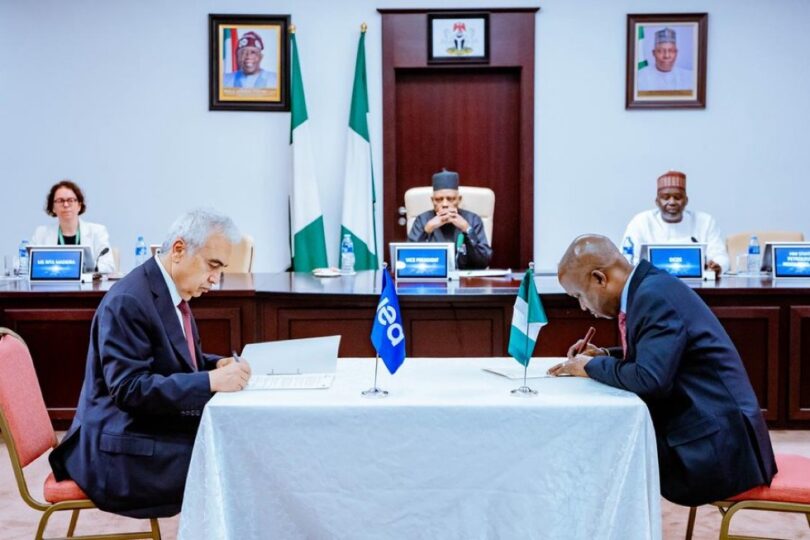
Nigeria and the International Energy Agency (IEA) have signed a Joint Work Programme aimed at strengthening cooperation on energy policy, data development, investment and energy security.
The agreement was signed on Thursday, September 3, 2026, as Nigeria formally commenced its partnership with the Paris-based organisation as an Association Country.
This was disclosed in a statement by the Senior Special Assistant to The President on Media & Communications, (Office of The Vice President), Stanley Nkwocha, on Thursday.
Vice-President Kashim Shettima, who spoke on behalf of President Bola Tinubu at the signing ceremony, described Nigeria’s admission into the IEA as a major milestone and a reflection of the gains recorded through the administration’s economic reforms.
Shettima said the development also validated the government’s policy choices and efforts to harness Nigeria’s abundant energy resources.
“Nigeria’s admission as an association country with the IEA is a significant milestone for our country and it reflects Nigeria’s strategic importance in the global energy landscape and the confidence that IEA has placed in our commitment to constructive international energy cooperation,” he said.
The Vice-President said the partnership would give Nigeria access to the agency’s expertise and institutional resources to support the country’s energy ambitions.
Given Nigeria’s energy potential, Shettima said, “the country will benefit from IEA’s institutional knowledge, the intellectual resources, the reach and expertise to support our nation’s ambitions in this sector.”
He said Nigeria was endowed with significant renewable energy resources and reaffirmed the administration’s commitment to repositioning the economy by leveraging the country’s available resources.
Shettima also assured the IEA of Nigeria’s readiness to work with international partners in advancing discussions around a fair and just energy transition.
The IEA Executive Director, Dr Fatih Birol, said Nigeria’s admission followed extensive consideration and consultations with the country’s authorities.
Birol explained that the IEA covers various energy technologies, including oil, gas, solar, nuclear power, artificial intelligence and electric vehicles.
According to him, Nigeria’s admission was approved unanimously by the IEA Board, comprising the governments of the United States, Japan, Germany, Italy and the United Kingdom.
Birol said the agency would support Nigeria’s energy sector over the coming years through policy advice, data and technical expertise.
“The IEA will accompany the Nigerian energy sector for the next few years to come for a much better energy future. We will provide policy advice from clean cooking to gas markets, from gas markets to training Nigerian experts at the IEA on our own,” he said.
The Minister of State for Petroleum Resources (Gas), Ekperikpe Ekpo, said Nigeria’s admission into the IEA was a result of the performance of the Tinubu administration and the reforms undertaken by the government.
He said the Joint Work Programme would facilitate greater involvement of IEA technical experts in developing data to guide energy policy and investment across the value chain.
The Minister of State for Foreign Affairs, Ambassador Sola Enikanolaiye, described the partnership as strategically important to Nigeria, while acknowledging the role played by the Nigerian Mission in Paris in facilitating the process.
He said the Ministry of Foreign Affairs would support the initiative to ensure Nigeria derives maximum benefit from the partnership.
“Our role is to ensure that whatever government does at home is projected effectively in advancing and promoting the interest of Nigeria,” he said.
“We take this as a critical component of our national interest and we will not fail in ensuring that we assist, as facilitators and coordinators, in ensuring that the maximum benefit of this endeavor is derived for the benefit of the Nigerian people.”
The Director-General of the Energy Commission of Nigeria, Dr Mustapha Abdullahi, said the Commission had previously worked with the IEA on the joint sponsorship of Nigeria’s National Energy Master Plan despite the absence of a formal framework for their relationship.
He expressed optimism that Nigeria’s new status and the Joint Work Programme would deepen cooperation between both organisations.